

Visual Field Analyzers
↵
Why Choose Us
Global Expertise
We have global expertise and knowledge to cater to customers around the world.
Quality Control
We have built a professional quality control team to accurately inspect every raw material and every production process.
Innovate And Move Forward
VisualTech is committed to innovative self-development, constantly striving to lead the industry while adhering to the highest standards of quality.
Advanced Equipment
A machine, tool or instrument designed with advanced technology and functionality to perform highly specific tasks with greater precision, efficiency and reliability.
What is Visual Field Analyzers
Visual field analyzers are often used in detection and diagnosis of Glaucoma, AMD, Scotomas and brain abnormalities. These analyzers test the full horizontal and vertical field of peripheral vision, identifying potential diminished or blind spots (scotomas) in the patients’ vision. Identifying specific scotomas in ones vision can be indicative of a certain type of brain trauma or disease, such as a stroke or tumor. The patient is directed to identify certain light stimuli provided by the analyzer in their peripheral vision, if the patient is unable to detect the stimuli, then this could indicate trauma and/or scotomas.


Benefits of Visual Field Analyzers
Diagnosis and Staging
A Visual Field Analyzers is performed at the initial visit or as soon as glaucoma is suspected. It evaluates vision loss due to glaucoma, damage to the visual pathways of the brain, and other optic nerve diseases. When glaucoma is diagnosed the visual field data is used to determine the severity of disease. This staging information is useful in choosing a target intraocular pressure and determining follow-up.
Following for Progression
After the initial diagnosis the doctor will repeat the Visual Field Analyzerst to check for worsening disease. This may be done in three to twelve months depending on the severity. If there are worsening defects or new areas of damage, a lower intraocular pressure and change in therapy may be needed. Many studies have shown that visual fields are variable over time and there is a learning curve when taking the test, so your doctor may ask you to repeat the test to confirm your results.
Abundant inspection modes for both accuracy and speed
Rich threshold inspection and suprathreshold inspection modes to detect early visual field defects.The scientific and intelligent interactive inspection strategy improves work efficiency. It only takes 3 minutes to inspect the 30° field of view.
Comprehensive Analysis Software
6 kinds of analysis: Reliability analysis, single-report analysis, multi-report analysis, glaucoma half-field analysis, glaucoma progression analysis, VFI visual field index analysis.Half-field analysis designed for glaucoma makes glaucoma diagnosis easier.Analysis of glaucoma progression, where very subtle progression is more visible and continues to suggest new progression.
Types of Visual Field Analyzers
Automated Visual Field Analyzer
The BIO-1000 automated visual field analyzer is a static perimeter designed to provide accurate and speedy diagnosis and monitoring of visual nerve diseases and glaucoma. Based on the International Goldmann standard design, the product is developed to offer crucial inspection modes for patients and provide them with optimal visual care.
Projection Perimeter
Auto self-checking when powered on, real-time display of self-checking procedure, detailed checking list presented. Easily obtain the current status of the projection perimeter.
Auto Projection Perimeter
BIO-1100 auto Projection Perimeter is an advanced diagnostic tool that is mainly used to detect visual field defects in patients. It executes the Goldmann international standard for visual field measurement and provides the most comprehensive inspection modes.
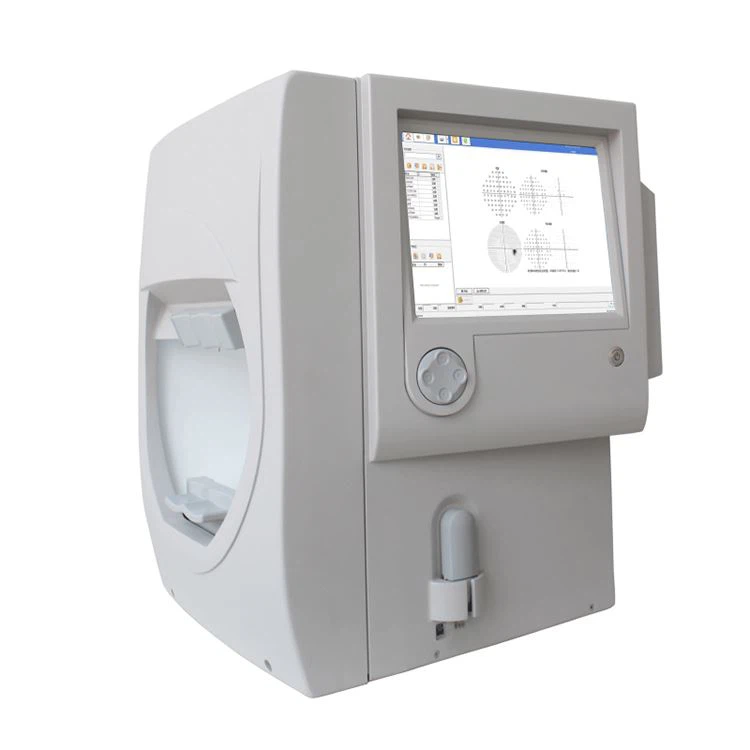
Application of Visual Field Analyzers
Screening for glaucoma: Peripheral vision loss is often an early and subtle sign of glaucoma. Visual field tests help detect vision loss and make the diagnosis of glaucoma, and repeat testing is used to monitor treatment.
Screening and testing for lid droop (ptosis)
Testing for toxicity from certain medications (for example, screening for toxicity from hydroxychloroquine [Plaquenil], which can affect the central retina)
Measuring the extent of retinal diseases, such as retinitis pigmentosa
Detecting conditions affecting the optic nerve, such as tumors, injury, poor circulation or stroke, optic neuropathy, swelling of the optic nerve (optic neuritis), compression from swelling in the eye socket or orbit, and severe nutrient deficiencies
Detecting conditions that affect the visual pathways from the optic nerves to the occipital lobe of the brain, including tumors, inflammatory disease, increased intracranial pressure, injury, poor circulation, or stroke
Testing for malingering behavior or factitious disorders
Components of Visual Field Analyzers
Display screen
Used to display patterns, light spots or other visual stimuli during the test. The patient needs to look at the display screen to complete the test.
Concave mirror or spherical mirror
Used to adjust the size, brightness and position of the pattern or light spot on the display screen to ensure that the patient's visual field can be accurately stimulated during the test.
Eye positioning system
Used to ensure that the patient's eyes remain in a stable position during the test, usually including components such as headrest and chin rest.
Eye tracking system
Some advanced visual field analyzers are also equipped with eye tracking systems, which can monitor the movement trajectory of the patient's eyeballs in real time to help analyze the relationship between eye movement and visual field range.
Computer system
Used to control the operation of the visual field analyzer, display test results, store data, and perform data analysis and report generation.
Test program
The visual field analyzer is usually equipped with a variety of test programs, such as static visual field test, dynamic visual field test, strabismus test, etc. Doctors can choose the appropriate test program for visual field analysis according to their needs.
Data processing software
Used to process and analyze test result data, generate visual field maps, statistical charts, etc., to help doctors diagnose and monitor diseases.
Calibration system
The visual field analyzer needs to be calibrated regularly to ensure the accuracy and reliability of the test results.
How to Choose Visual Field Analyzers
Test Menu and Analytical Capabilities
Assess the analyzer's test menu and analytical capabilities to ensure that it can perform the necessary tests required for your laboratory's diagnostic needs. Look for analyzers that offer a comprehensive range of tests and parameters relevant to your specialty or focus area.
Accuracy and Precision
Accuracy and precision are paramount in blood chemistry analysis. Evaluate the analyzer's performance specifications, including coefficients of variation (CV), linearity, and calibration stability, to ensure reliable and reproducible results.
Ease of Use and Workflow Integration
Choose an analyzer that is user-friendly and seamlessly integrates into your laboratory's workflow. Consider factors such as instrument interface, software functionality, sample handling automation, and compatibility with laboratory information systems (LIS).
Maintenance and Service Requirements
Assess the analyzer's maintenance and service requirements, including calibration procedures, instrument downtime for preventive maintenance, availability of technical support, and service contract options.
Cost and Budget Considerations
Evaluate the total cost of ownership, including initial purchase price, reagent costs, maintenance expenses, and ongoing operational costs. Choose an analyzer that aligns with your budget constraints while meeting your performance and functionality requirements.
Regulatory Compliance and Accreditation
Ensure that the analyzer complies with regulatory standards and accreditation requirements applicable to your laboratory setting, such as Clinical Laboratory Improvement Amendments (CLIA) regulations and accreditation by organizations like the College of American Pathologists (CAP) or the International Organization for Standardization (ISO).
How to Use Visual Field Analyzer?
Setting up the Visual Field Analyzer
To set up the Visual Field Analyzer, begin by ensuring the Field Analyzer HFA II-i Series equipment is properly connected to the network using a network cable.Calibration is vital to guarantee accurate results. Regular maintenance of the equipment ensures optimal performance. Stay vigilant for software updates to maximize functionality.Data security is paramount, so configure the system to export reports securely. When setting up, configure the system to export visual field reports in .tiff format and establish shared folder access.Ensure proper network connectivity by entering the workgroup or domain name. Save settings diligently after each setup step to avoid data loss and maintain system integrity.
Conducting a Visual Field Test
When conducting a visual field test using the Visual Field Analyzer, ensure proper patient positioning and calibration of the equipment for accurate and reliable results. To conduct the test effectively, consider the following:Patient positioning: Ensure the patient is comfortable and correctly positioned to maintain steady fixation.
Interpreting the Test Results
When interpreting the test results of a visual field examination, focus on analyzing the item difficulty, discrimination, reliability coefficient, and distractor evaluation for comprehensive evaluation. Understanding implications of these factors is crucial in identifying abnormalities.Analyzing patterns in the results allows for comparing data across different sections of the visual field. Evaluating reliability through the reliability coefficient helps ensure the consistency of the test outcomes.

How to Maintain Visual Field Analyzers
Regular cleaning of Visual Field Analyzers ensures that it is ready for use when needed, that stubborn stains/substances do not get a firm hold, and that experiments are not contaminated by impurities carried over from previous experiments.The equipment is always cleaned before and after each use.Cleaning reagents and cleaning aids used are specific for laboratory equipment care.In addition to cleaning Visual Field Analyzers before and after each use, a schedule is required for more in-depth cleaning. This might involve dissembling certain machines to clean hard-to-reach parts.Always follow instructions from the manufacturer on cleaning policy.Certain parts of the equipment might require very specific solvents, cleaning materials, or drying procedures.
Calibration involves comparing the measurements of equipment against the standard unit of measure, for the purpose of verifying its accuracy and making necessary adjustments. Regular calibration of laboratory equipment should be done because over time, biases develop in relation to the standard unit of measure.This guards against invalid data and ensures safety during experimentation. An independent specialist, that can provide calibration certificates where necessary, should be engaged in the process.The recommended time by the manufacturer elapses.The equipment is hit by a force, dropped on the ground, or involved in an accident or event of safety concern.There are unusual patterns or sounds while the equipment is in use.Measurements obtained are questionable.Highly critical measurements, where data accuracy is of utmost importance, are to be carried out.
Visual Field Analyzers is generally costly and repairs and refurbishment prolong the lifespan of equipment, saving the lab the expense of new purchases.Repair and/or refurbish faulty or worn-out Visual Field Analyzers without any delay. Faulty machines may stop working suddenly in the middle of an experiment leading to losses and they can also be a source of safety concerns.Minor repairs can be done by a dedicated staff, while major repairs should be directed to specialists with knowledge of the specific machine or equipment.Refurbish old equipment to give them a new lease of life by cleaning thoroughly, polishing where necessary, lubricating movable parts, and replacing small worn out bits.
Equipment that cannot be repaired or refurbished should be replaced. It is advisable to buy equipment from well-known sources that can guarantee quality and offer technical support.High-quality Visual Field Analyzers is easier to maintain and its durability translates to reduced costs in the long term.Non-faulty equipment that is too old should also be replaced, while some wear and tear might not be noticeable during its operation, outdated machines are not reliable and technical support in terms of servicing and acquisition of spare parts may be limited.
Global Automated Visual Field Analyzer Market Analysis
Rapid Technological Advancement And Developments In The Analyzer Technology
In the modern era, there is a number of advancements that are being introduced in automated field analyzers. New software algorithms have been introduced, which is one of these significant advancements in the complex technology of this equipment. A surge in the frequency of product launches is one of the main factors projected to fuel the market's expansion. Recent developments in the technology are leading to the development of various novel visual function tests.
Offers Reduced Turnaround Time To Doctors And Patients
The turnaround time for automated visual field analyzers has greatly decreased, and accuracy in visual field testing has increased in contrast to recent years. Due to a number of efforts and initiatives being taken by several market players operating in the automated visual field analyzer market, the turnaround time of these analyzers has been reduced significantly. With the lesser turnaround time, doctors at several clinics are now able to accelerate the pace of diagnosis and treatment of their patients.
Lack Of Precision And Versatility Of Analyzers
Despite a number of benefits of an automated visual field analyzer, there is a major drawback of this technology. Automated visual field analyzers are highly prone to making errors due to a number of factors. For example, the result of a test conducted with the automated field tester can be very easily hampered by incorrect placement of the head. Even a slight movement in the position of the patient's head can completely influence the result. Moreover, patients with severe glaucoma are very hard to be diagnosed accurately.
Our Factory
VisualTech (Shanghai) Corporation, commonly referred to as VisualTech, is a professional supplier of ophthalmic equipment, optometry and ophthalmic medical instruments, as well as optical lab equipment for the eyeglasses. The company is located in the bustling metropolis of Shanghai, China.VisualTech is committed to innovative self-development, constantly striving to lead the industry while adhering to the highest standards of quality. The company provides customers with high-quality, innovative and trustworthy services.


certificate

FAQ
We're well-known as one of the leading visual field analyzers manufacturers and suppliers in China, specialized in providing high quality products and service. We warmly welcome you to buy or wholesale cheap visual field analyzers in stock here from our factory.