

Slit Lamp Microscope
Why Choose Us
Global Expertise
We have global expertise and knowledge to cater to customers around the world.
Quality Control
We have built a professional quality control team to accurately inspect every raw material and every production process.
Innovate And Move Forward
VisualTech is committed to innovative self-development, constantly striving to lead the industry while adhering to the highest standards of quality.
Advanced Equipment
A machine, tool or instrument designed with advanced technology and functionality to perform highly specific tasks with greater precision, efficiency and reliability.
What is Slit Lamp Microscope
Slit Lamp Microscope a standard diagnostic procedure also called biomicroscopy. This exam combines a very bright light with a microscope. You sit in a chair facing a microscope with a bright light, with your forehead and chin resting on a support. The eye doctor then uses this instrument to examine your eyes in detail to determine whether they have any problems or abnormalities.


Benefits of Slit Lamp Microscope
High Resolution
The 1/2.5 inch CMOS sensor produces high-quality pictures with a resolution of 5 Megapixels with an imaging of 2,592 x 1,944 pixel arrays.
Enhanced Auto Exposure
For auto exposure, the target area size can be changed easily via moving the mouse lightly.
Plug and Play USB
For simple plug-and-play, USB data transfer. It is not necessary to use complex computer configurations or additional hardware.
Powerful Image Processing
For all images PNG, JPG formats are available. In BMP, format can be edited for brightness, contrast, sharpness, zoom, etc. It has Practical Software Management with simple design and intuitive interface that allows doing easy operation. We have also professional patient information database supports centralized management.
Types of Slit Lamp Microscope
LS-3 Ophthalmic LED Slit Lamp is an entry-level product that provides exceptional performance. It uses a warm LED light source to ensure that the color is accurately reproduced, resulting in optimal observation outcomes. The long life-span LED also ensures low energy consumption.
High quality halogen bulb provides a soft and comfortable illumination. The bulbs are durable and long-lasting, making them ideal for use in a professional setting.The lighting can be adjusted to suit the needs of the user. The maximum aperture diameter 14mm. Applanation tonometer is an optional accessory.
A handheld slit lamp is an instrument used by eye care professionals to examine the eye and diagnose various eye conditions. It is a handy tool that allows them to assess the eye's structure and function, including the cornea, iris, lens, vitreous, and retina.Portable slit lamps come with various features that make them versatile and easy to use. One of the most significant features is its lightweight and portable design, making it easy to move around and use in various locations.
The digital slit lamp with software has a user-friendly design that allows operators to capture high-quality images quickly and efficiently.The equipment base has a dimmer knob that allows the operator to adjust the brightness of the light source and operate the handle with one hand.It features an automatic eye recognition function, which can identify and record the eye being examined without manual input.
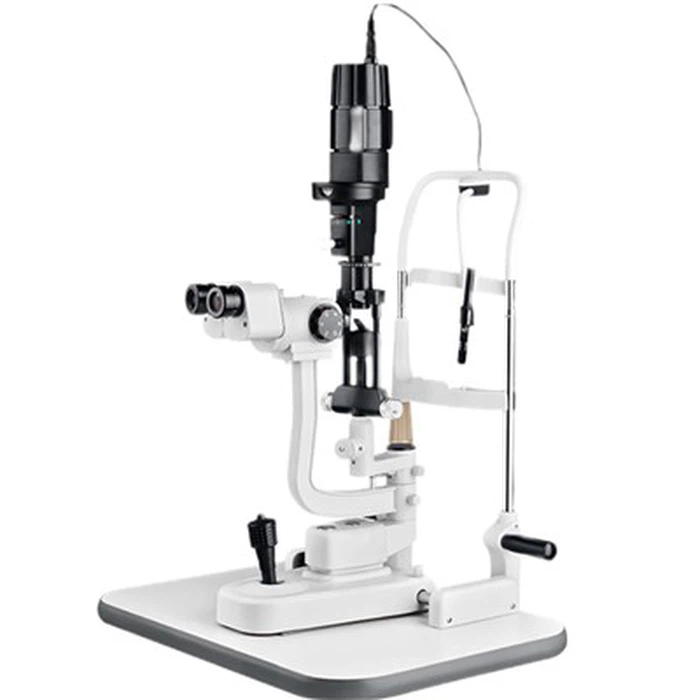
- Corneal and conjunctival infections
- Eye allergies
- Retinal detachment: In this eye condition, an important part of eye present at the back of the eye,i.e Retina detaches from the base, resulting in a decrease or loss of vision
- Corneal injury: This refers to a tissue injury covering the eye surface.
- Retinal vessel blockage: Blood vessel obstruction in the eye causes a gradual or sudden vision loss.
- Cataract: This is a clouding of the eye lens that significantly affects a person's ability to see clearly.
- Macular degeneration: This chronic condition affects the part responsible for central vision.
Components of Slit Lamp Microscope
Base
The slit lamp base includes an adjustable table, power switch, intensity rheostat, locking carriage and joystick.
Patient support frame
The patient support frame of a slit lamp includes a forehead band, chin rest, chin height adjustment knob, patient handles and canthus height indicator.
Illumination arm
The illumination arm of the slit lamp includes a light source, illumination filters, beam height adjustment, slit illuminator, beam width adjustment and centre screw.
Viewing arm
The slit lamp viewing arm includes oculars and a magnification control knob.
What does a Slit Lamp Microscope Examine?
Cornea
The cornea is the clear, curved front part of the eye. The slit lamp test can help diagnose dry eye by examining this part of the eye. The thickness (and thinness) of the cornea can be determined which can show several corneal-specific abnormalities causing blurred or loss of vision.
Lens
The clear portion behind the pupil that focuses light is the lens. Typically the lens is examined for the presence of a cataract, the clouding of the body's natural lens. As we all know, cataracts happen as we age and are easily fixed with cataract surgery.
Sclera
The sclera is the white part of the eye and consists of strong fibrous tissue that protects the outermost layers of the eye. Slit lamp exams help doctors see inflammation, discoloration and other abnormalities of the sclera. The conjunctiva, an extremely thin, transparent layer over the sclera, can also be examined for conjunctivitis, commonly known as pink eye, as well as other diseases.
Retina
The retina is the thin layer of photoreceptor cells at the back of the eye. These cells send signals to the optic nerve which relays light and vision to the brain. Slit lamp exams can determine many conditions including age-related macular degeneration and retinitis pigmentosa. Another issue to be examined for are torn or detached retinas-a critical issue that requires immediate treatment to prevent blindness.
Optic nerve
As mentioned above, the optic nerve attaches to the brain. This nerve can be damaged by glaucoma, which is heightened pressure within the eye. Glaucoma works slowly and can be difficult to diagnose but a slit lamp exam can help diagnose it early, leading to treatment and prevents loss of vision.
Lid and lashes
The structures around the eyeball are examined for signs of inflammation, infection or any disease. Bumps on eyelids are often evaluated with a slit lamp.
Features of Slit Lamp Microscope
It has a one-touch magnification switch that makes it easy for doctors to do inspections.
It also has a maximum illumination angle of up to 60 degrees that gives better slit view for the cornea, etc.
It supports both AA rechargeable and dry cell batteries. You can easily purchase it anywhere. After being fully charged, these batteries will provide more than 4 hours of operating time.
It has a long working life and a 3500k colour temperature that creates a perfect observation environment with the warm LED illumination. It also helps doctors relieve visual fatigue.
It comes with standard accessories that include carrying case, battery charger, forehead support, and instrument manual.
How to Choose Slit Lamp Microscope
Slit lamps come in one of two illumination types-the tower illumination type (a.k.a “Haag Streit”) and the integrated illumination type (a.k.a “Zeiss”). What’s the difference? The Haag Streit style provides the light source from the top of the instrument, while the Zeiss style supplies the light source from the base. It is ultimately a practitioner’s preference as to which illumination type is needed. There are a number of illumination techniques that are used during a typical examination; i.e. retro, diffuse/direct, focal broad beam, focal slit illumination, specular reflection, and sclerotic scatter—all allowing the examiner to view the various structures and tissue of the eye correctly.
The higher the slit lamp magnification power, the better! At least 20x is required on most slit lamps; however, obtaining a slit lamp with 40x magnification is best for performing a more thorough examination. It is ideal to begin the exam with a larger field of view and gradually increase the magnification power for areas of particular interest.
This is the adjustment feature of the slit (light). Similar to the magnification power, the slit length/width should be adjustable to use different methods of observation. Van Herick’s technique requires a 60° slit and 6x-10x magnification into the limbus to measure the angle of the anterior chamber. A 45°-60° angle and 16x-20x magnification is needed to perform either the conical beam or corneal cross-section techniques. Depending on the exams your practice is performing, you will want to understand the width/length features of your slit lamp.
Most slit lamps offer cobalt blue, red free, neutral density, heat absorbing, grey, yellow filter and/or diffuser. Whether you are assessing the tear film quality and break up (cobalt blue), or differentiating pigment lesions from blood vessels in the retina (red free), be sure to review the filter capabilities of the slit lamp you are purchasing to find the one that best fits the needs of your practice. Refer to the comparison chart below for more information.
There are many other characteristics that are important to professionals in the field, but light source is a hot topic for many. Most modern slit lamps offer a halogen or LED source option for illumination. LED bulbs last much longer and many examiners feel these offer a “cooler” light to make viewing the retina easier. LED does not emit heat like halogens can, making them more comfortable for the patient.There are a variety of slit lamps on the market today that offer these features, with some offering more than others, but let us be sure to compare apples to apples. Here is a brief look at the top slit lamp manufacturers and how their features compare:
How to use the Slit Lamp Microscope: 6 key skills to learn
Positioning
Get yourself positioned before the patient. you can always raise or lower the pt's chair to get them in position, but if the slit lamp isn't at the right height for you, it's much more difficult to adjust your own chair . I can't tell you how many residents we see ignore personal ergonomics. You will regret it later when poor habits lead to neck strain, poor exams, and fatigue. We've seen many folks who, by the time of fellowship, have neuropathies and back pain.
The dilated retinal exam
During your first few days, you'll feel like you'll never see the retina. After a week of practice, you'll wonder why you ever struggled. This is really a matter of practicing to build muscle memory. Each lens has an optimal distance from the eye and slit lamp. Younger individuals with relatively healthy eyes are the best to start practicing on. Older individuals with pathology like cataracts or old vitreous heme will make it difficult to see the fundus initially and it may be hard to tell if your technique is wrong or of it's just a difficult view.
The undilated optic nerve exam
When the dilated slit lamp exam is second nature to you, the undilated exam will be the next step. This exam is crucial for glaucoma patients, as we normally don't dilate those patients in clinic as it can raise the IOP unnecessarily.
Moving around in the eye
One of the most frustrating things that beginners experience is being unable to shift your field of view significantly once they get a good view of the fundus. Try the following:“Walk the dog”: The best way to move your field of view is not to move the joystick OR the lens independently. Rather, move BOTH the joystick on the slit lamp AND the lens in the same direction VERY slowly simultaneously. This is a game changer for many people we teach. Once you master this, you will be shocked at how much you can see when the eye is in primary position. In undilated exams, the only way to move around and consistently find the fundus and the macula is by using this technique.
Checking for cell and flare
The right magnification is key! Use only the 16x mag with the beam of light angling in from the side. Always use the brightest light in the darkest room! Look for cells over the pupil, it's the darkest part giving you the greatest contrast. Use the following SUN grading criteria to grade your exam.
Checking intraocular pressure by applanation
By the end of your first year of residency, you'll have performed this step at least a few thousand times.
How to Maintain Slit Lamp Microscope

Slit Lamp Microscope position
Place the slit lamp in a place that is accessible to both staff and patients, some of whom may have physical disabilities.A power outlet should be provided nearby, and the power cord should not be located in the passage of staff or patients.The slit lamp should not be exposed to extreme temperatures, such as direct sunlight or extreme temperatures generated by air conditioning.Slit lamps should be stored in a dry environment, because if the optical components are exposed to a humid environment (humidity and heat), fungal growth (mold or mildew) may occur on the optical components.

Slit Lamp Microscope parts
Spare light bulbs and fuses should be placed within easy reach to avoid delays in patient care.The recommended minimum inventory of bulbs and fuses is two per slit lamp.When using parts, they should be restocked immediately.
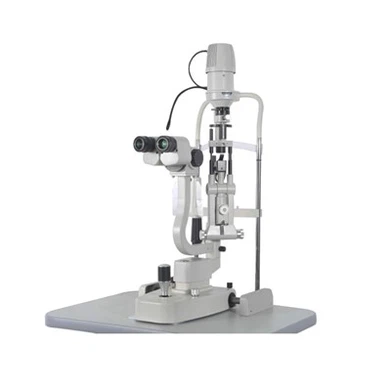
Replace the Slit Lamp Microscope bulb
When handling or replacing the slit lamp bulb, be careful not to leave fingerprints on the bulb. The oil on your fingers will cause hot spots on the bulb, which will shorten the life of the slit lamp bulb. Usually, use paper towels or cotton gloves to handle the slit lamp bulbs.Check whether the replacement position of the slit lamp bulb shell is correct, otherwise the quality of the slit beam will be affected. The distorted beam can be corrected by adjusting the position of the housing.
Clean Slit Lamp Microscope
The slit lamp should be cleaned at least once a week, if in a dusty environment, it should be cleaned more frequently.Use a cloth dampened with water to clean the slit lamp housing. Do not use other liquids or corrosives.The exposed surfaces of the eyepiece optics (1) and objective lens (2) should be cleaned with a soft optical dust-proof brush. If additional cleaning is required after dust removal, you should carefully wipe the lens with a lens cleaning cloth or cotton swab and lens cleaning solution.
Our Factory
VisualTech (Shanghai) Corporation, commonly referred to as VisualTech, is a professional supplier of ophthalmic equipment, optometry and ophthalmic medical instruments, as well as optical lab equipment for the eyeglasses. The company is located in the bustling metropolis of Shanghai, China.VisualTech is committed to innovative self-development, constantly striving to lead the industry while adhering to the highest standards of quality. The company provides customers with high-quality, innovative and trustworthy services.


certificate

FAQ
We're well-known as one of the leading slit lamp microscope manufacturers and suppliers in China, specialized in providing high quality products and service. We warmly welcome you to buy or wholesale cheap slit lamp microscope in stock here from our factory.