

Trial Lens Set and Frame
VisualTech (Shanghai) Corporation, commonly referred to as VisualTech, is a professional supplier of ophthalmic equipment, optometry and ophthalmic medical instruments, as well as optical lab equipment for the eyeglasses. The company is located in the bustling metropolis of Shanghai, China. VisualTech provides comprehensive global coverage, responding to the ever-changing needs of the times. The company has adapted to the transition of traditional offline exhibition models to convenient & efficient online shopping methods. Wherever the need arises, VisualTech is there to provide its superior products and exceptional customer service.
Why Choose Us?
Professional Team
VisualTech (Shanghai) Corporation, commonly referred to as VisualTech, is a professional supplier of ophthalmic equipment, optometry and ophthalmic medical instruments, as well as optical lab equipment for the eyeglasses.
Wide Range of Products
VisualTech offers a diverse range of products to the ophthalmic industry. Includes combined tables, autorefractor, digital lensmeter, phoropter, visual charts, trial lens sets, trial frames, ophthalmic slit lamp, non-contact tonometer, fundus camera, retinoscope & ophthalmoscope, perimeter, AB scan, Biometer, dry-eye analyzer etc.
Global Shipping
VisualTech provides comprehensive global coverage, responding to the ever-changing needs of the times. The company has adapted to the transition of traditional offline exhibition models to convenient & efficient online shopping methods. Wherever the need arises, VisualTech is there to provide its superior products and exceptional customer service.
Quality Control
VisualTech is committed to innovative self-development, constantly striving to lead the industry while adhering to the highest standards of quality. The company provides customers with high-quality, innovative and trustworthy services.


Trial lens set is a kind of ophthalmology calculating apparatus, used by hospital ophthalmology and glasses shop to exam people's dioptric situation: hyperopia, myopia, presbyopia, astig- matism strabismus or color blindness. Trial frame that holds trial lenses used during retinoscopy or refraction tests on the eye.
Trial lens set is an ophthalmology calculating apparatus used in the department of ophthalmology in hospitals and glasses shops to exam a patient's refractive error including hyperopia, myopia, presbyopia, astigmatism, strabismus or color blindness. It usually contains sphere lens, cylinder lens, prism lens and other accessory lens, etc. Following is the details of all the major components.
● Sphere lens
The curved surface focuses all paraxial parallel rays to one point (usually called the virtual focus) and the dioptric power on all axes positions is the same. Spherical lens includes concave lens (-) and convex lens (+). The former is used to correct myopia and the latter hyperopia and presbyopia.
● Cylinder lens
The curved surface forms a part of cylindrical lens and the dioptric power on all axes positions is not the same. After passing through the lens, the light beam focuses on a straight line (or a broken line). Cylindrical lens consists of concave (-) and convex (+) cylindrical lens. They are used to correct astigmatism.
● Prism lens
The tangent plane of a prismatic lens is a cuneiform. After passing through the lens, the light beam bends to the bottom and the object shifts towards edges. This kind of lens is used to exam and correct strabismus or heterophoria as well as to train eye-muscle.
● Occluder (BL)
This is an opaque lens used to cover the uninspected eye.
● Cross lens (CL)
There are two mutual vertical lines on the plane lens, used for locating pupil's center and measuring intraocular distance.
● Frosted lens (FL)
This is a semi-transparent cover lens and mainly used for babies or used outdoors to replace occluder.
● Slit Lens (SS)
There is a slit in the center, which is the only way light beams can pass through. By rotating this lens in front of the patient's eye, astigmatism can be examined as your vision changes in better or in worse at a certain axis position. On the contrary, it proves no astigmatism if the patient's vision has not changed during the rotation.
● Plano lens (PL)
Plano lens are transparent lens with no dioptric power. It is usually used to determine malingering blindness.
● Color Lens (RF, GF)
This kind of lens has different colors, e.g. red, green, blue, yellow and dark brown and is used to examine color sensitivity.
● Cross cylinder (Jacson cross cylinder, JCC)
This is a kind of lens with contrary dioptric power in two axis positions and can be used to examine the degree and axis position of the cylindrical lens when determining astigmatism.
When using, put the cross cylinder lens before cylindrical lens and make one of its axis positions overlap that of the cylindrical lens. Then overturn the cross cylinder lens, the axis will turn 90° and observe the change of vision. If the patient's vision has no change, the degree of cylindrical lens used can be considered as suitable.
● Maddox lens (MR)
Maddox lens is made of glass rods that convert a light spot into a streak 90o from the axis of the rods. It is used to measure the strength of eye muscle and to examine latent and real strabismus.
Put the Maddox lens in front of one eye and have the patient watch with both eyes. If a light spot he/she observes with his/her bare eye is on the line formed by the Maddox lens, the patient has neither strabismus nor latent strabismus. Otherwise he/she has one of them. If the light spot is on either side of the vertical line, he has horizontal strabismus. If the light spot is above or below the horizontal line, he has vertical strabismus. Then the strabismus can be corrected by using a prism lens, which makes the light spot coincides with the line. The strength of the prism indicates the degree of latent or real strabismus in prism diopters.
● Pin hole (PH)
In its center, there is a small hole, through which light beam penetrates to form an artificial pupil and it is used to improve diopter especially the astigmatism.
135°is used to inspect visional function, balance both eyes, and mix function. 45° is used to inspect latent strabismus, stereoscopic vision, unequal vision and so on.
1. The trial lens set is designed to help determine the most suitable corrective lens to fit on the patient's optical frame in order to correct the visual defect.
2. Prismatic lenses are used to treat phorias, strabismus, measure vergence and in visual rehabilitation. They introduce a deviation of the incoming light beam (therefore also on neutral lenses), whose extent is measured in prismatic dioptres. The prismatic effect of 1 prismatic dioptre is equivalent to the deviation by 1 cm of the original light beam, measured at a distance of 1 m from the lens.
3. The set of trial lenses consists of 76 prismatic lenses with a 38mm diameter. Intended for use in combination with trial frames and trial clip-ons suitable for 38mm diameter lenses.
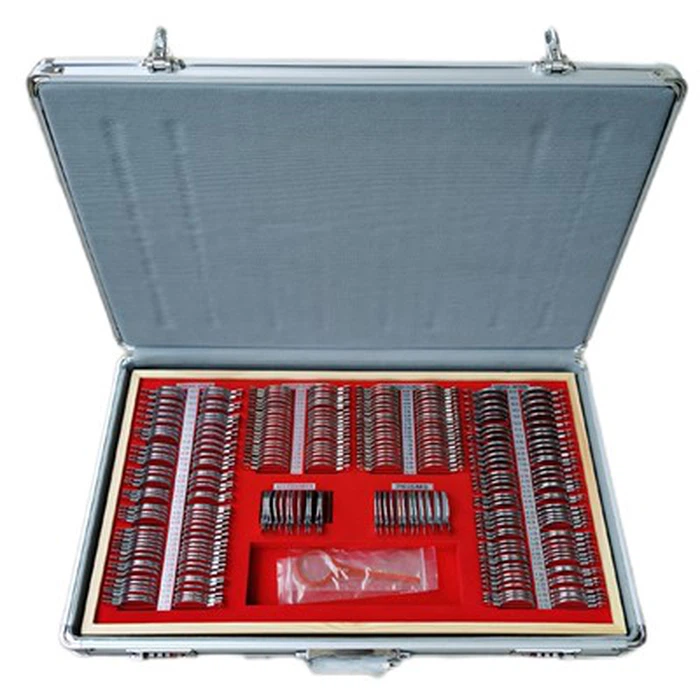
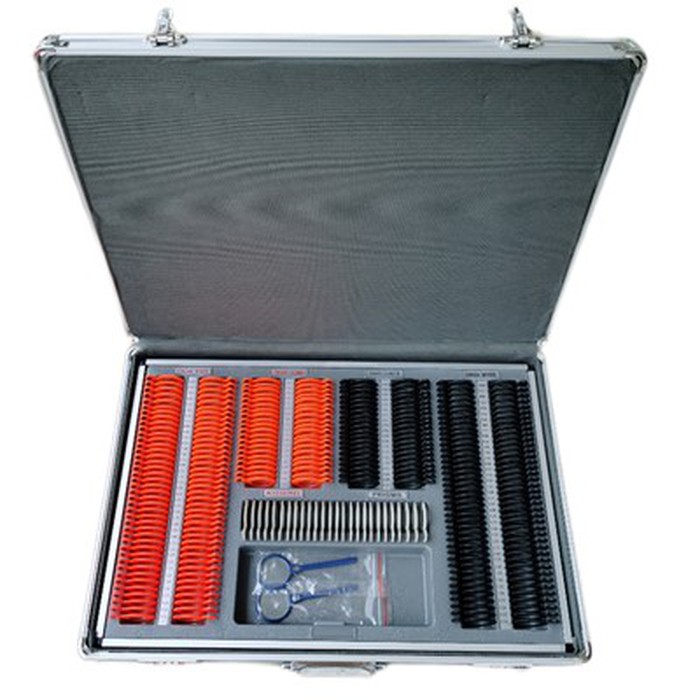
All lens rings of trial lens set are made of durable and light material that's color-coded for easy identification.
● The rings are also provided with index marks to ensure precise positioning. The plus and minus axes of the cylinder power lenses and the cross cylinder unit, in particular, are clearly identified.
● These lenses are designed for use at the standard 12 mm corneal destance.
● All lenses are fitted in a sturdy, dustproof attache case with cushioned lid for full protection when carrying and storing.
Trial Lens Set Specifications
Box 104 non-diaphragm lenses
Delivered in a suitcase with a fixed tray
Contents of the test box 104 glasses:
Sphere:
CONVEXE + with two glasses per power: from +0.25 to +2.00 in steps of +0.25 from +2,00 to +5.00 in steps of +0.50 of +5.00 at +10.00 in steps of +1.00
Sphere:
CONCAVE - (2 glasses per power): From -0.25 to -2.00 in steps of -0.25 from -2.00 to -5.00 in steps of -0.50 from -5.00 to -10.00 in steps of -1.00
Cylinder: + (2 glasses per power): From +0.25 to +1.00 in steps of +0.25 +2.00, +3.00
Cylinder: - (2 glasses per power): From -0.25 to -1.00 in steps of -0.25 -2.00, -3.00
Prism: 0.50, 1.00
Complementary glasses: Red glass, black glass, frosted, pinhole
Cylinder cross 0.25

A trial frame is a tool used by ophthalmic professionals like ophthalmologists and optometrists. It is basically an adjustable spectacle frame with multiple cells, used to hold corrective lenses, and other accessories in subjective refraction (finding the correct spectacle power) and retinoscopy.
Trial frame – an essential tool for eye examinations and vision testing. This versatile and adjustable frame allows optometrists and ophthalmologists to conduct thorough and precise eye exams with ease.
The trial frame is designed to accommodate a wide range of lenses, making it suitable for testing patients with varying vision needs. With its adjustable bridge and temples, this trial frame can be customized for a comfortable fit for every patient, ensuring accurate results during the examination process.
● Key features:
1. Adjustable bridge and temples for a customized fit
2. Accommodates a wide range of lenses for comprehensive vision testing
3. Durable construction for long-lasting use
Built with durability in mind, the trial frame is constructed with high-quality materials to withstand the rigors of daily use in a professional practice. Its sturdy design ensures that it will remain a reliable tool for eye examinations for years to come.
Whether you are a seasoned optometrist or a student in training, the trial frame is a must-have addition to your eye examination toolkit. Experience the convenience and accuracy that this versatile trial frame offers as you provide your patients with the highest standard of eye care.
Upgrade your practice with the trial frame and elevate the standard of your eye examinations. Ensure precise and reliable results in every vision test, and provide your patients with the quality care they deserve. Trust in the trial frame for all your vision testing needs.
Functions of Trial Frame

Function
● Space for a total of 10 tl trial lenses of 38 mm diameter
● PD range from 46 – 78 mm
● Adjustable temple tilt and length
● Smooth axis adjustment
● CVD scale
Ergonomics
● Easy trial lens insertion
● Self-braking nose-bridge adjustment
● User-friendly controls in "soft design"


Comfort & Material
● Operating controls are a good distance away from the patient's face
● Minimal pressure thanks to large rests and optimal weight distribution
● Closed frame temple design prevents hair from getting caught
● Flexible and anatomically adjustable mixed-material ear pieces
● No lubricants needed
● Dermatologist recommended safe materials
Compatibility & Design
● Compatible with DIN and BSI Standard trial lenses
● Slip-on polarizing filter with 2 settings (near/distance) available as an optional extra
● Timeless, attractive design increases patient acceptance
Benefits of Trial Frame
Affordability
The trial frame offers excellent value for money, combining high quality with an attractive discounted price for students.
Precise fit
The adjustable features of the trial frame, including the bridge adjustment, pd adjustment, temple length adjustment, and rotating cylinder adjustment, ensure a precise and comfortable fit for accurate vision correction.
Versatility
This trial frame is suitable for various educational and clinical settings, catering to the needs of students, optometrists, and other eyecare professionals.
Our Certificate

FAQ
We're well-known as one of the leading trial lens set and frame manufacturers and suppliers in China, specialized in providing high quality products and service. We warmly welcome you to buy or wholesale cheap trial lens set and frame in stock here from our factory.